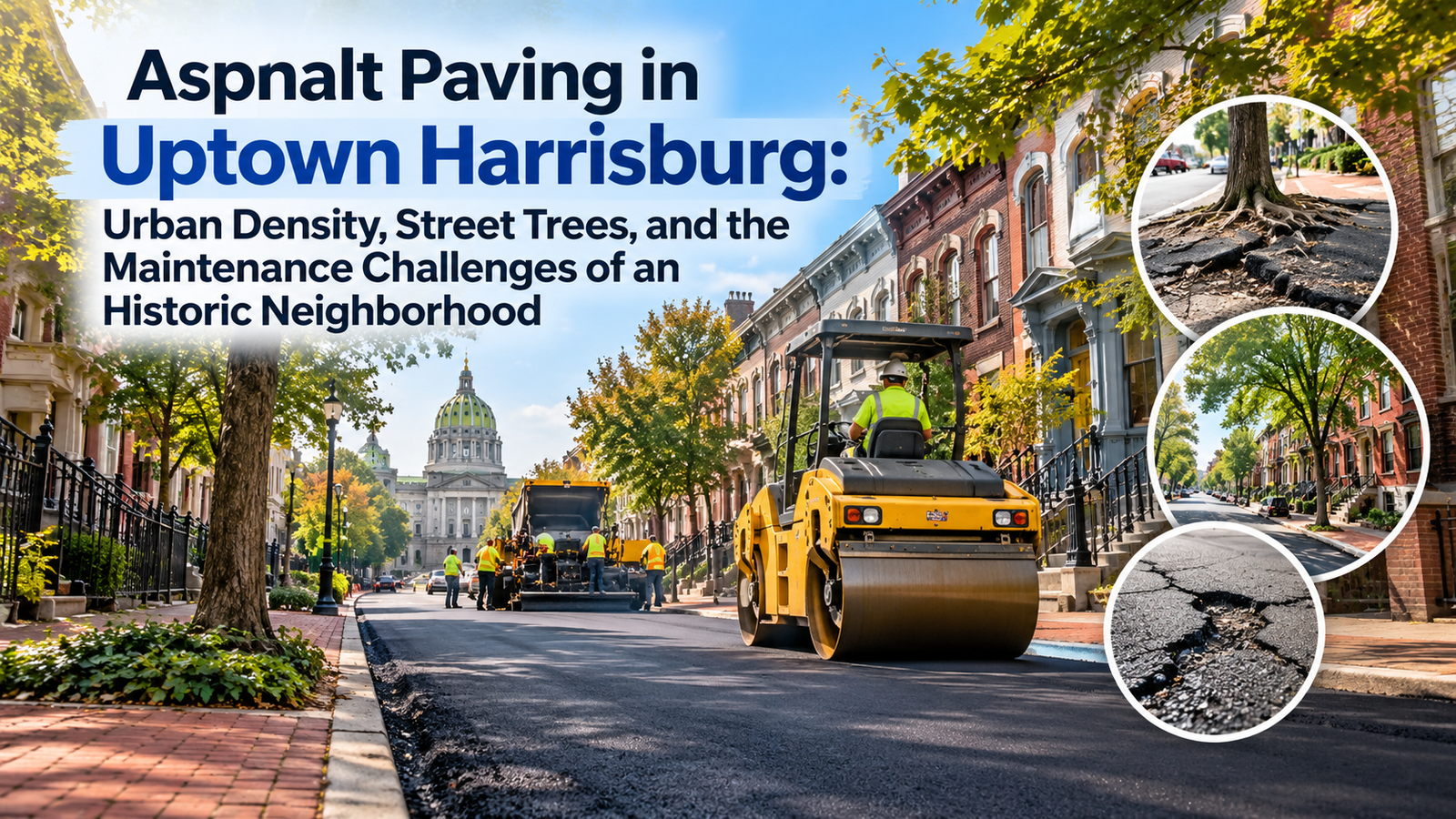
Uptown Harrisburg refers to the residential neighborhoods north of the downtown Capitol district and generally north of Forster Street, encompassing neighborhoods like Midtown, Old Uptown, and the area extending toward the Reservoir Park and Emerald Street corridors. This is one of the most architecturally rich areas of Harrisburg characterized by densely packed rowhouse blocks, original brick and stone sidewalks, mature street tree canopies, and narrow rights-of-way that were designed for horse-drawn traffic and adapted incrementally for automobiles.
Pavement in Asphalt Contractor Uptown Harrisburg faces an unusual combination of challenges. Urban density means that equipment access is limited, tree roots are ubiquitous, and every paving project must be coordinated with utilities, neighboring properties, and the city’s Department of Public Works. The neighborhood’s age means that underlying infrastructure sewer lines, water mains, gas distribution pipes was installed in the late nineteenth and early twentieth centuries and may be in various states of repair. The climate means that central Pennsylvania’s 35 to 50 annual freeze-thaw cycles are relentlessly working on every cracked or unsealed surface.
The Urban Density Problem: Equipment Access and Staging in Uptown
Uptown Harrisburg’s street grid was established in the mid-nineteenth century. Alley widths of 10 to 15 feet are common behind rowhouse blocks, and side-lot driveways may have clearances of less than three feet from the property line to the foundation of the adjacent structure. These spatial constraints fundamentally shape how paving work can be executed.
Full-size commercial paving equipment triple-drum rollers, full-width pavers cannot operate in many Uptown alleys and side-lot driveways. Compact paving machines, walk-behind rollers, and hand tools for detail work at edges and tight corners are the operational tools for much of the residential paving work in this neighborhood. This does not mean the work is less thorough it means the equipment selection must match the specific site constraints.
Material delivery is another logistical consideration. Hot-mix asphalt must be placed at the correct temperature to achieve proper compaction. In Uptown’s narrow streets, delivery truck access may require temporary street closures coordinated with the City of Harrisburg Bureau of Police and Department of Public Works. Maintaining mix temperature during longer material runs from the plant to remote alley locations requires insulated truck beds and coordinated delivery schedules.
Street Tree Roots: The Most Common Source of Pavement Distress in Uptown
Uptown Harrisburg has one of the most extensive urban tree canopies in the city. The tree-lined residential streets planted primarily with silver and red maples, pin oaks, and London plane trees in the late nineteenth and early twentieth centuries are a defining character element of the neighborhood. They are also the most common source of pavement distress in the area.
Urban trees in confined soil volumes grow their root systems laterally, seeking water and air in the subsurface zone immediately beneath pavement. Root systems of large maples routinely extend 30 to 50 feet from the trunk, and they concentrate their fine feeder roots in the two-to-four-inch zone beneath pavement where moisture collects. The mechanical force of root growth against a pavement surface can lift slabs and asphalt sections by several inches over a period of years, creating trip hazards in sidewalks and structural failure in driveways.
Managing root intrusion in pavement replacement requires a decision about how aggressively to address the root system. Complete root removal risks damaging the tree; root pruning at the excavation boundary, combined with physical root barriers, is the preferred approach when the goal is to retain the tree. Where trees are diseased or have already caused structural pavement damage that cannot be mitigated, removal coordinated with the city’s urban forestry program may be necessary. Any street tree removal in Harrisburg requires a permit from the city.
The Age Factor: What Beneath-Surface Infrastructure Means for Paving Projects
Pavement work in Uptown Harrisburg regularly reveals infrastructure that pre-dates the current building stock. Sewer lines installed in the 1890s, terra cotta water mains replaced incrementally through the twentieth century, and gas distribution infrastructure of varying ages all run beneath the streets, alleys, and driveways of the neighborhood. Before any paving project that involves excavation including edge repairs, base replacement, and utility trench repairs 811 notification and utility marking is required.
Private service laterals the pipes running from public mains to individual rowhouse units are often the same age as the building they serve. These lines may be in poor condition and may not be at the depth that current standards require. Excavation near old laterals should be done carefully, with hand-digging in the tolerance zone around marked utilities, to avoid damaging brittle cast iron or terra cotta pipe that cannot absorb the impact of mechanical excavation.
When underground conditions are discovered during a paving project cracked and settled utility trench areas, subsurface voids from deteriorated sewer lines, or areas of poorly consolidated fill the appropriate response is to address the subsurface problem before placing new asphalt. A new surface over an unstable base will fail prematurely, and the cost of doing the work twice exceeds the cost of addressing the root cause the first time.
Historic Character and Pavement Materials in Uptown
Uptown Harrisburg has several blocks of historic brick and stone pavement in alleys and some sidewalk areas. These materials are a character-defining feature of the neighborhood and in many cases are protected under the City of Harrisburg’s historic preservation guidelines. Paving contractors working in Uptown should be aware of the potential for historic paving materials beneath layers of asphalt overlay that have been applied over decades.
When historic brick pavement is uncovered during a project, the appropriate course of action is to notify the property owner and, if the pavement is in a public right-of-way, the city’s Bureau of Engineering. The decision about whether to preserve, restore, or cover the historic material involves the city’s historic preservation officer and may require a review period before work can continue.
For asphalt paving projects that adjoin historic sidewalks or alleys, edge details must be handled carefully to prevent water infiltration at the material transition joint. A sealed, properly compacted joint between new asphalt and adjacent historic paving prevents moisture from working under either surface.
Sealcoating and Crack Maintenance in Uptown’s Urban Environment
The same freeze-thaw dynamics that affect pavement throughout the Harrisburg metro apply with particular intensity in Uptown, where shade from the dense tree canopy means that winter ice and snow persist longer than in more open suburban locations. Shaded pavement warms more slowly after cold nights, extending the period during which freeze-thaw cycling can occur at the daily timescale.
Sealcoating in Uptown’s residential alleys and driveways requires managing the logistical constraints of the dense urban environment. Equipment must fit in narrow spaces. Application in areas shaded by buildings and trees must account for slower drying times. Neighbors must be notified of access restrictions during and after application. These are manageable challenges for contractors familiar with urban paving work, but they add time and care to the process.
Frequently Asked Questions: Asphalt Paving in Uptown Harrisburg
How does dense urban development affect pavement installation?
Equipment access, material delivery logistics, and utility density all create operational constraints in Uptown that require compact equipment, coordinated delivery schedules, and careful utility pre-marking. These constraints are manageable with proper planning.
What do street trees do to driveways and alley pavement?
Root systems spread under pavement seeking moisture, lifting and cracking surfaces from below. Management options include root pruning with physical barriers, or tree removal when damage is severe. Any street tree removal requires a city permit.
Why is pre-marking utilities important before paving in Uptown?
Uptown’s nineteenth and early twentieth-century infrastructure includes lines at non-standard depths and in non-standard materials that are vulnerable to mechanical damage. 811 marking and hand-digging in the tolerance zone are essential before any excavation.
Can historic brick pavement be preserved when asphalt work is done nearby?
Yes. When historic pavement is discovered, the city’s historic preservation officer is typically involved in the decision about treatment. Edge details between new asphalt and historic materials must be carefully sealed to prevent moisture intrusion.
How does tree shade affect sealcoating application and performance?
Shaded surfaces dry more slowly and retain moisture longer after rain and snowmelt. Sealcoating in shaded areas requires appropriate application temperatures and sufficient drying time. Shaded pavement also stays frozen longer in winter, intensifying freeze-thaw effects.
Asphalt paving in Uptown Harrisburg requires a contractor who understands the specific character of this urban neighborhood its spatial constraints, its tree canopy, its underground history, and its climate conditions. The work demands more preparation, more careful equipment selection, and more coordination than comparable work in open suburban settings, but the result durable pavement that respects and supports the historic character of one of Harrisburg’s most distinctive residential areas is well worth the investment.